
Driving in Morocco with a UK or EU licence: rules, speed limits and tips
Morocco’s road network is one of the best in Africa: modern motorways, paved national roads, and signs in Arabic and French. For a European or North American driver it is easy to get around, as long as you know a few local rules and habits. Here is the essential information, from the validity of your licence to parking outside the medina of Fes (also spelled Fez).
Is your licence valid in Morocco?
Yes, for a tourist stay. Licences issued by the United Kingdom, the European Union countries, Switzerland, Canada or the United States are recognised during the first three months after you enter the country. An international driving permit is not required; it only serves as a translation. However, the original licence must be shown at every check: a photocopy or a photo on your phone is not enough. Keep the rental agreement and the vehicle papers provided by the agency in the car.
Essential rules and speed limits
You drive on the right, as in continental Europe and North America; UK and Irish drivers will need a moment to adjust. Seat belts are compulsory in every seat, holding a phone at the wheel is prohibited, and children travel in a suitable car seat (the child seat is free with our cars). The general limits are 60 km/h in town, 100 km/h on roads and 120 km/h on motorways, but the signs take precedence: many villages along the way are limited to 40 or 60 km/h, and unmarked speed bumps are common at the entrance to towns.
A few local habits worth knowing: at roundabouts, priority in principle goes to vehicles already on the roundabout, but stay cautious, not everyone applies it; pedestrians cross anywhere in town; two-wheelers and carts share the road in rural areas; a flash of headlights from an oncoming vehicle often warns of a police check or a hazard further on.
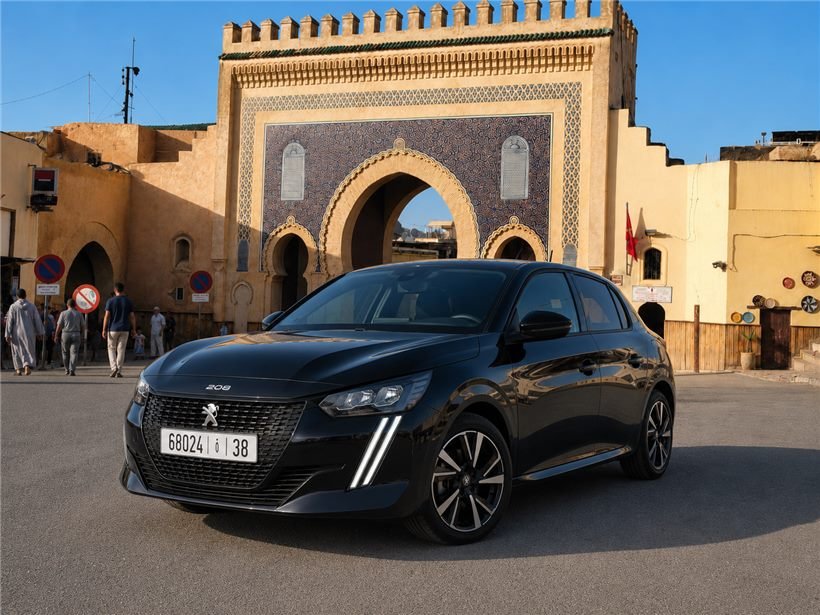
Motorways and tolls
Fes is linked by the A2 motorway to Meknes, Rabat and Casablanca to the west, and to Taza and then Oujda to the east. The motorways are tolled, payable in cash at the barrier (keep some dirhams in coins and small notes); some toll plazas accept bank cards and the local electronic toll tag. The amounts depend on the distance travelled and remain modest by European standards. Service areas offer fuel, cafés and toilets; they are further apart than in Europe, so fill up before a long stretch.
Speed cameras, checks and fines
Speed checks are frequent: signposted fixed cameras, mobile gendarmerie speed traps on the way out of towns and on the national roads, and police checkpoints at the entrance to built-up areas. If an offence is recorded, the officer offers an on-the-spot fine to be paid there and then against an official receipt. The most common rates, as a guide, are 400 MAD for exceeding the limit by 1 to 19 km/h or for using a phone at the wheel, and 700 MAD for exceeding it by 20 to 29 km/h. Above that, the penalties are heavier and may include your licence being withheld. Stay polite, show your documents and always ask for the receipt.
Fuel and petrol stations
In mid-October 2026, diesel sells for around 15.6 MAD per litre and unleaded petrol for around 15.3 MAD, with slight variations from one town to another. Prices are reviewed every two weeks. Most of our cars are diesels: check the label on the fuel flap or ask the agent when the keys are handed over. Petrol stations (Afriquia, Shell, TotalEnergies, Winxo, Petrom…) are plentiful in town and on the main routes, usually with attendant service; in rural or mountain areas they become sparser: set off with a full tank for Merzouga or the Middle Atlas and keep some cash, as cards are not accepted everywhere.
Driving and parking in Fes
The Ville Nouvelle, with its wide avenues and roundabouts, is easy to drive; traffic is heavy in the late afternoon, especially on Avenue Hassan II and around the train station. The medina of Fes el-Bali, on the other hand, is entirely pedestrian: you leave the car in one of the attended car parks at the gates, for example near Bab Bou Jeloud or Bab R’cif, then continue on foot or in a red petit taxi. All over town, car park attendants in high-visibility vests watch over the cars parked along the streets in exchange for a few dirhams: it is the custom, and it works.
Our customers staying in a riad in the medina have the car handed over at the gate closest to their accommodation; we agree on the meeting point when you book. For everything else, the free GPS supplied with the car and a phone with mobile data are more than enough to find your way around.
Mountains, desert and night driving
Middle Atlas (Ifrane, Azrou, Midelt): the roads are paved and well maintained, but in winter snow can fall on the passes, notably the Zad pass between Azrou and Midelt. Check the forecast, set off early and, in heavy snowfall, wait for the snowploughs to come through rather than pushing on. All our vehicles are two-wheel drive: they are suitable for these roads in normal conditions.
South and desert (Errachidia, Erfoud, Merzouga): the road is paved all the way to Merzouga; you do not need a 4x4 to get there. Excursions into the dunes are done in the 4x4s of local operators. In summer, drive early in the morning, take water with you and never venture onto the tracks with a rental car.
At night: avoid driving after dark outside the towns as far as possible. The roads are poorly lit, some vehicles drive without lights, and animals (donkeys, dogs, livestock) may cross. If you have to drive at night, reduce your speed.
In case of an accident or breakdown
- Get to safety, switch on the hazard lights and set up the warning triangle.
- In an accident involving another party, fill in the accident report form (a copy of the standard “constat amiable” is in the glovebox of our cars) and take photos; if anyone is injured or there is a disagreement, call the police (19 in town) or the Royal Gendarmerie (177 outside built-up areas).
- Call the agency immediately: at COSTA CAR, roadside assistance can be reached 24/7 on +212 673 92 14 21 (phone or WhatsApp), and a replacement vehicle is arranged if necessary.
- Do not have the car repaired anywhere without the agency’s agreement.
Would you rather have an automatic for town and mountain driving? 11 of our 14 cars come with one: see our page on automatic car rental in Fes. For the roads of the Middle Atlas and the South, discover our SUVs.
Frequently asked questions about driving in Morocco
Can I drive in Morocco with a UK or EU licence?
Yes. A valid UK, Irish, EU, US or Canadian driving licence is recognised for a tourist stay during the first three months after you enter Morocco. Always carry the original with you, together with your passport and the car’s papers.
What are the speed limits in Morocco?
As a general rule: 60 km/h in built-up areas (sometimes 40 km/h in certain town centres), 100 km/h on roads and 120 km/h on motorways, unless a sign shows a lower limit. Fixed and mobile speed cameras are common, especially at the entrances to towns and on the main national roads.
Can I have a drink before driving in Morocco?
No. Driving under the influence of alcohol is prohibited and, in practice, there is zero tolerance. Do not take any risk: checks do happen and the penalties are severe.
How do I pay a fine in Morocco?
Common offences (speeding, using a phone at the wheel) are dealt with by an on-the-spot fine paid to the officer, who hands you an official receipt. Always insist on that receipt. The most frequent amounts are 400 MAD or 700 MAD depending on the offence, as a guide.
Can I drive into the Fes medina?
No. The medina of Fes el-Bali is pedestrian-only and its alleyways are inaccessible to cars. You park in one of the attended car parks at the gates (Bab Bou Jeloud, Bab Guissa, Bab R’cif…) and carry on on foot. Keep a few dirhams for the attendant.
Read next
Renting a car in Morocco
Documents, insurance, debit cards, comparison sites: what to know before you book.
Read the guide →Fes – Merzouga: the desert road
Around 475 km via Midelt and Errachidia, stages and tips.
Read the guide →Fes – Ifrane and the cedar forest
An hour’s drive to the Middle Atlas, and winter precautions.
Read the guide →Hit the road with peace of mind
Full insurance included, 24/7 assistance in English or French, unlimited mileage and free GPS on all our cars.